


Publications
Research Focus Areas
Research at the Institute of Building Materials Science is divided into four areas, which are reflected in the structure of the research groups. In addition, the institute, in collaboration with other institutes of the Faculty of Civil Engineering and Geodesy at Leibniz University, is heavily involved in key focus areas such as wind energy research.
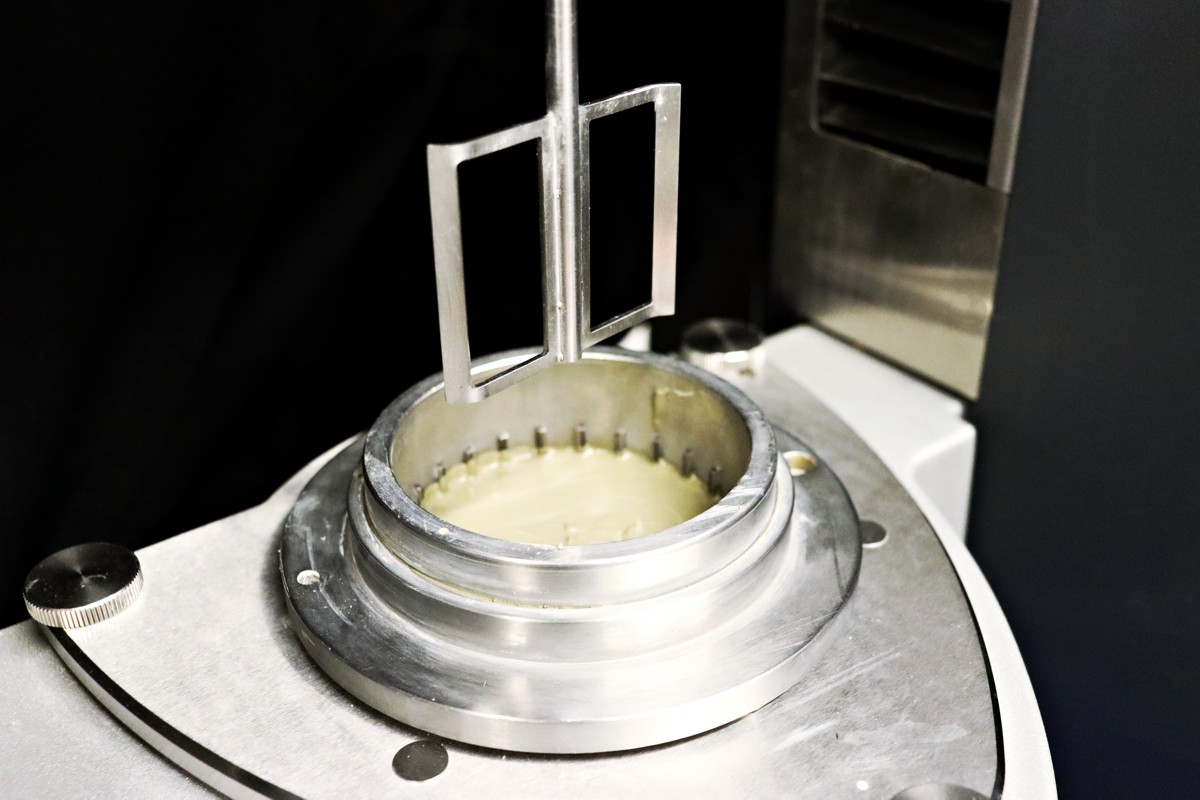
Traditionally, the Institute of Building Materials has been strongly active in concrete technology since its founding over 50 years ago, for example in the development of novel concretes and the control of concrete processing properties. A central focus of Prof. Michael Haist in this area is to make concrete development, production, and monitoring digitally plannable, measurable, and controllable. To this end, innovative sensor systems are combined with artificial intelligence methods to enable, for example, self-learning concrete production. More information can be found on the pages of the Concrete Technology research group at the IfB.


 ©
IfB
©
IfB
Hannover—the birthplace of fatigue research founded by August Wöhler—is one of the world’s leading centers for concrete fatigue studies. Under the leadership of Prof. Michael Haist, this research area has been significantly expanded to include issues related to concrete shrinkage and creep. In this field, we investigate the microstructural causes of deformation and fatigue failure, and develop constitutive laws and design models for future standards, such as Model Code 2020 and 2030. More information can be found on the pages of the Concrete Behavior Under Mechanical Loading research group at the IfB.


 ©
Quelle: IfB
©
Quelle: IfB
Concrete Micromechanics: Understanding the microstructure of concrete is still limited today and poses a significant challenge for the targeted modification of material properties. Using the institute’s excellent experimental facilities, the micromechanical properties of the nanoscale components of concrete can be explored at the IfB. These insights form the foundation for entirely novel types of concrete. More information on this topic can be found on the pages of the Microstructure Analysis and Micromechanics research group at the IfB.


 ©
FBG/C. Bierwagen
©
FBG/C. Bierwagen
The Concrete Vision Lab conducts innovative research in the fields of machine learning and computer vision and their applications in materials and building materials science. Its overarching goal is the exploration and development of novel, data-driven, and sensor-supported methods for the analysis and characterization of building materials, with a focus on the automatic determination and prediction of fresh and hardened concrete properties. This work relies on highly interdisciplinary expertise, combining the scientific disciplines of building materials, computer vision, and data science. More information on this topic can be found on the pages of the Concrete Vision Lab at the IfB.